
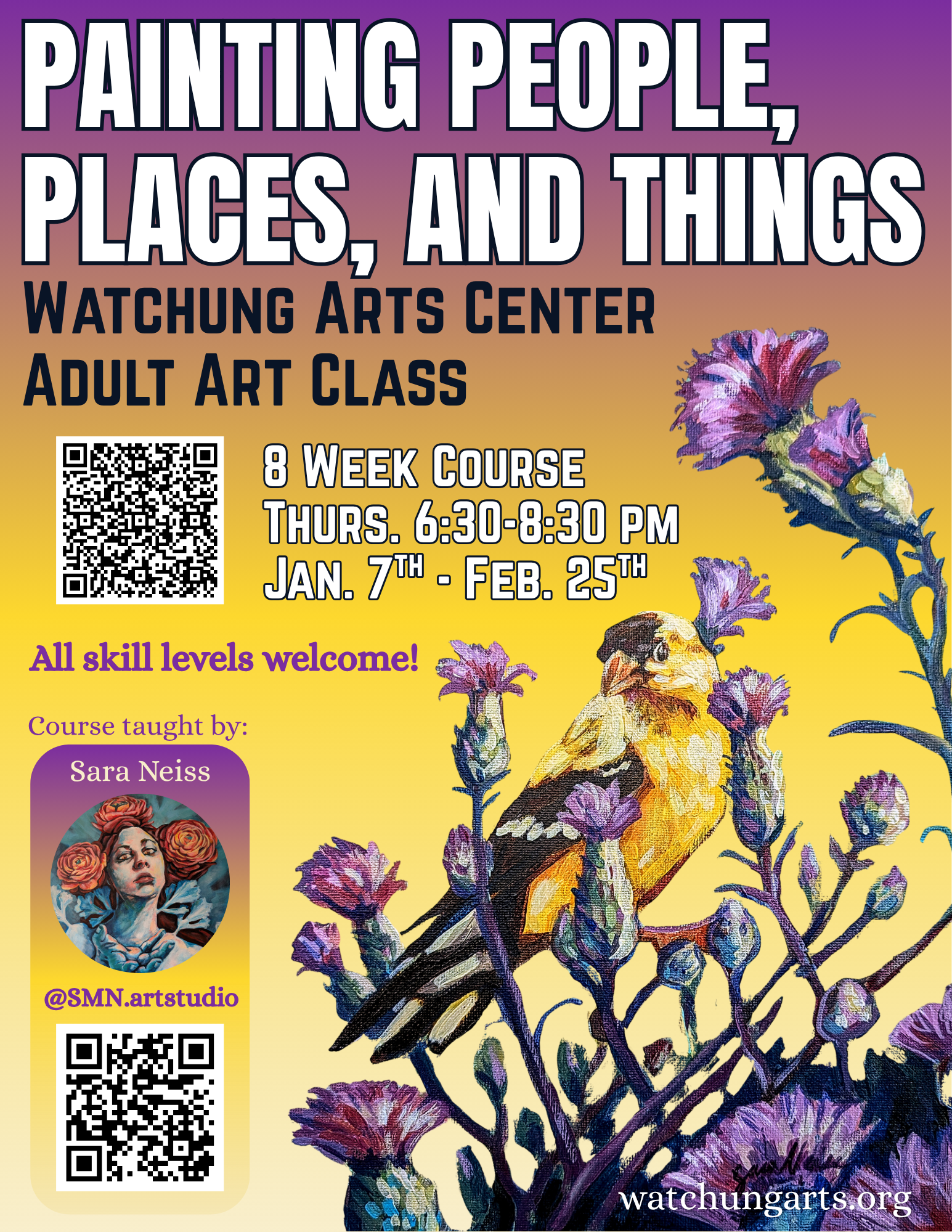
Painting People, Places and Things
ADULT CLASSES
Instructor: Sara Neiss
Sara Neiss grew up in Watchung attending children’s summer camp at the WAC, fostering a lifelong interest in the arts. She went on to earn her BFA in Fine Arts and BS in Mechanical Engineering at Alfred University. She now lives in Rahway and continues to paint and make ceramics.
Please note that class registration is not fully complete until the required form and payment are complete.
If you are signing up after the first class, please send an email to watchungarts@gmail.com to complete payment. Each class will cost $45 plus the one time studio fee of $30 when enrolling for anything less than the full 8 week course.
Painting People, Place and Things
Thursdays 6:30-8:30pm
8 weeks
Description
Students will learn and apply basic techniques in depicting form and depth of field applied across different classical subject matter. The class will start with still life, then move to landscape, and finish with the student’s choice of person or animal.
Experience Level
All experience levels are welcome. The difficulty of the class will be determined by how students challenge themselves in composition selection.
Instructor Contact Info
Sara Neiss
smsneiss@gmail.com
(908)458-1072
Class Rules
1. Be respectful of yourself and others.
2. Be respectful of the space. Clean your station.
3. During critiques, try to use a compliment sandwich. (Compliment. Hard critique. Compliment.)
4. Never leave untouched canvas-white on a finished piece.
5. Challenge yourself to never put unmixed/untinted white or black directly on the canvas.
6. Have fun!
Syllabus
Section 1: Color, Hue, and Form
(2 classes)
Students will develop or build on their existing foundation in color theory through painting objects from life.
Students will start with simple exercises in color mixing and move on to painting a 1-3 object simple still life. The instructor will review concepts of shape, form, and value.
Section 2: Landscape and Depth of Field
(3 classes)
Students will select an image with a foreground, middle ground and background, and learn techniques to create a sense of distance within a 2D image.
Good images for this assignment include but are not limited to landscapes and interior spaces. Concepts covered in this section may include atmospheric perspective, vanishing points, local color, and glazing. More advanced students will be encouraged to select images with elements of foreshortening or forced perspective.
Section 3: People and Animals
(3 classes)
Students will build on previously learned concepts around form and texture through the depiction of a human or animal. The instructor will review concepts explored in previous sections in the context of the new subject matter as well as explore techniques in building texture and contrast. More advanced students will be encouraged to select a dynamic composition featuring movement or tension, while beginners may want a more stagnant/focused reference photo.
Course Material
Students are expected to come to the first class with paint brushes. Paints supplied by the
instructor for the first class will be available after for future classes, but are not guaranteed to
last the full course. After the first class students will be responsible for bringing their own
canvases (2-3), paints, and brushes.
1. Paint brushes: (synthetic bristles): bring a range of brush sizes
● At least 1 round or pointed round (I would suggest 2 of different sizes)
● At least 1 flat and/or bright
● Suggest to try 1 filbert as well
● At least 1 flat/wash that is ¾ to 2 inches wide
● Optional: liner (suggested if you like fine detail)
2. Paint:
● Titanium white
● Cadmium yellow medium hue
● Cadmium Red medium or dark hue
● Ultramarine blue
● A brighter blue: Cerulean blue hue OR cyan blue OR teal (or phthalo/winsor blue)
● Raw umber
● To save on costs you can purchase a paint set with similar color range
3. Canvas: students will purchase their own canvases after the first class (2-3). It is up to the student to decide canvas size, but it is recommended to not go below 11×14. To save on costs,
students can select canvas board instead of stretched canvas.
Suggested paint Brands
● High quality: Golden open or heavy body
● Mid range: Winsor & Newton, or Utrecht
● Less expensive option: Utretch studio, Blick studio or Liquitex Basics (if you go with a less expensive option you might get 150-250 mL size for these instead of 60 mL)
Note: Students are free to make their own choices for paint color and brand. The above are merely instructor suggestion if you do not know where to start.
Answers to Common Questions
Can I just get a standard paint set that has different colors?
● Yes.
Do I have to purchase the exact list?
● No. You can make your own selections if you already know what you like to work with.
What size paint tubes should I get?
● 50-150 ml is probably good (22 ml might be on the small size but you could start there if you are unsure on your selections)
● I would suggest getting a larger container of white than the other colors
● Generally I would suggest getting bigger tubes (120-250 ml) if selecting the basics paint series (cheaper paints)
Why buy the more expensive paint series or brands?
● If you are a beginner or like working thinner (more water color feel), it might not be worth buying the more expensive brands.
● Typically, the main difference is the amount of pigment in the paint. With cheaper paints you will get more translucent colors. With more expensive paint, the same amount will go a longer way, especially if you also use medium.
● With acrylics, there can also be a slight color change after it dries and fully cures. I find the dulling of the color will be more noticeable with cheaper paints. This can be somewhat combatted with sealing finished work with vanish.
If I want to paint thicker (impasto) or with visible brush strokes, how should this affect my supply choices?
● Buy stiffer/courser brushes.
● Buy heavy body paint series. Do not buy the cheapest paint possible.
● Consider also buying an impasto medium or a gel based medium. If you purchase a medium make sure it is labelled specifically for acrylic (not oil or water-based oil)
Should I get brushes with natural or synthetic bristles?
● I would recommend synthetic for acrylic.
● Natural is more common for oil and water color.
What should I be doing between classes?
● Selecting/taking reference images and purchasing canvases for current assignments.
● It is encouraged but not expected for you to work on these pieces outside of class.
● It is always encouraged to keep a sketchbook! Challenge yourself to draw or doodle
everyday. It doesn’t have to be complex or complete.
● Bonus: I would also suggest keeping a running list in the back on your current sketchbook of different artists that interest you or someone mentions when looking at
your work.
● You can request mini-assignments such as color studies from the instructor.
How can I keep my painting from drying out so fast?
● If you are just concerned about paint on the palette and not the canvas, you can mist your palette with a spray bottle of water.
● If you want the paint on the canvas to stay wet longer for wet on wet painting and blending (alla prima), you can get a slow-dry medium
What is paint medium and why would I use it instead of water?
● Mediums are an additive you can mix into your paint to extend the paint or change the
consistency.
● Water thins the paint, but a specialized medium may be able to do the same effect with a better consistency or other benefits such as protecting against color fade. It mainly
comes down to artist preference.
● A medium may also affect the finish either increasing or decreasing the gloss/shine to
the final surface of your paint. Water generally will not affect this.
What types of medium are there?
● The retardant type or slow dry (either fluid or gel based) can slow drying time. The fluid type will thin the paint and may help with blending as well. The gel type will allow the paint to keep a thicker viscosity.
● Some mediums speed up drying time (though I’ve mainly seen those for oil paint not acrylic)
● Some mediums are designed specifically for thinning paint for glazing (this works better than water).
● If you are interested in texture and painting thicker you can also explore impasto or gel mediums.
How do I protect my finished pieces?
● You can apply a spray-on or paint on clear varnish.
● I would suggest satin (typically come in matte, satin or gloss), and look for non-yellowing and UV protection
● Varnishes can help
How long does it take for acrylic to fully dry and cure?
● It depends on thickness of the applied paint, room humidity, and use of a medium.
● Generally acrylic paint will be dry to the touch in a 5-30 minutes for normal layers and 1-2 hours for thick layers (can be longer if you are intentionally taking steps to keep it
damp).
● However, dry to the touch does not mean fully cured, and until then you can still remove layers with warm water. For normal layers curing will take 3-7 days, and for the thick layers/texture 2 weeks to 1 month.
Compositions Registration and Payment
Please choose the Registration button and sign up. Then, choose the payment button to pay.
